Homeowner guide
Salt Air and Your AC: A Bay County Homeowner's Guide
Heating and cooling equipment lives a harder life on the Gulf Coast. This guide covers what salt air and humidity actually do to a system, how close to the water counts as coastal, what "coastal-rated" means when a manufacturer says it, and a maintenance rhythm that holds up in Panama City, Panama City Beach, Lynn Haven and the rest of Bay County.
Updated October 2026. About a 10 minute read.
The short version
- Two things wear out coastal equipment: airborne salt corroding the outdoor unit, and humidity keeping the system running longer than it would inland.
- Salt exposure drops off quickly with distance from the water, but manufacturers still treat anywhere within one to two miles as coastal, and warranties generally exclude corrosion damage.
- "Coastal-rated" means coated or all-aluminum coils, a protected cabinet and sealed joints. It is worth specifying as standard here, not treating as an upgrade.
- Oversizing is the most common sizing mistake in Florida data and it hurts more in a humid climate, because a system that shuts off early barely dries the air.
- Rinse the outdoor coil every few months, change filters every one to two months, and have the system checked twice a year.
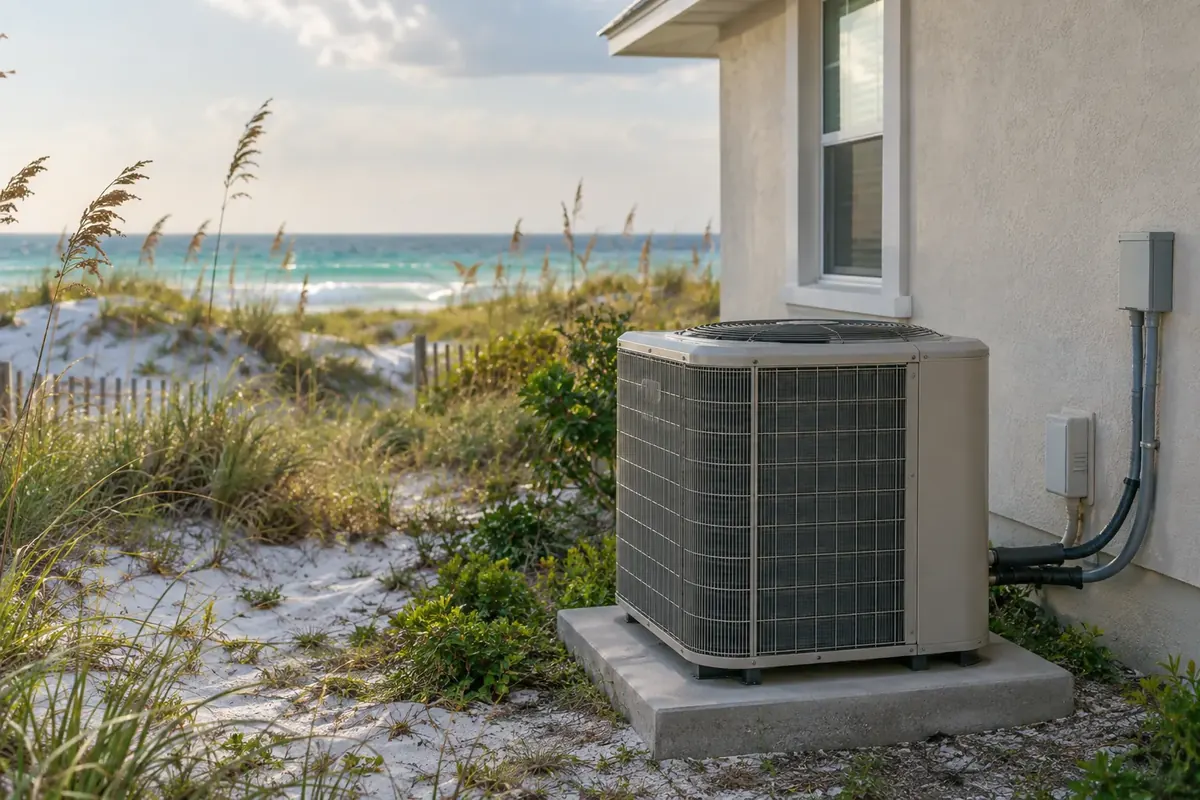
Why do AC units fail sooner near the coast?
AC units fail sooner near the coast because airborne salt corrodes the outdoor coil and the joints where copper meets aluminum, while Gulf humidity keeps the system running longer than it would inland. Corroded fins shed heat poorly, so the compressor works harder for the same cooling, and the extra run hours add wear.
The outdoor unit of an air conditioner or heat pump is a heat exchanger left outside. Its coil is made of thin aluminum fins pressed onto copper tubing, or on newer designs aluminum throughout, and it depends on bare metal to move heat. Near the Gulf, that metal sits in air carrying salt.
Salt attacks it in two ways. Chloride ions interfere with the thin protective oxide film that normally forms on aluminum, which lets pitting start and spread. Published work in the ASHRAE Journal notes that aluminum alloys are susceptible to pitting where chlorides are present. Then, wherever copper and aluminum touch, the two metals form a galvanic cell as soon as humidity dissolves the salt into an electrolyte. Aluminum is the less noble metal in that pairing, so it corrodes preferentially at the brazed joints. That is why Carrier's coastal units ship with heat-shrink sleeves over every copper-to-aluminum joint.
As fins pit and crumble, two things happen. The coil can shed less heat, so the system runs hotter and longer for the same result. And loose fin material can block airflow through the coil, raising head pressure and, in some cases, triggering nuisance shutdowns. The cabinet, base pan, fasteners and electrical components sit in the same air. Trane sells a kit specifically to protect variable-speed drive electronics on coastal units from salt deposits, which tells you the exposure reaches well beyond the coil.
One distinction worth making, because the two often get muddled: this is not the same as formicary corrosion. Formicary, or ant-nest, corrosion is an indoor coil problem driven by organic acids from household chemicals and building materials. It produces pinhole refrigerant leaks in copper, sometimes within months, and the ASHRAE paper notes it is rarely found in marine systems. If a technician says your indoor coil has formicary corrosion, salt air is not the cause and a coastal-rated outdoor unit will not fix it.
How close to the water counts as coastal?
A home counts as coastal for AC purposes if it sits within one to two miles of salt water. Trane recommends coated coils within one mile, and Carrier says salt carries up to two miles inland. In Bay County that takes in the Gulf front and the neighborhoods along St. Andrew Bay, North Bay and East Bay.
A peer-reviewed field exposure study measuring salt deposition at increasing distances from a shoreline found the steepest decline within the first few hundred yards, after which it continues to fall more gradually and remains measurable several miles inland. Wind direction, humidity and local geography shift the picture, so there is no single line on a map.
Manufacturers draw practical lines instead:
- Trane recommends epoxy-coated coil models for installations within one mile of salt water.
- Carrier describes salt being carried as far as two miles inland on its coastal product page, and separately says homeowners within ten miles may notice salt corrosion.
For Bay County specifically, the geography does most of the sorting. Panama City Beach, Mexico Beach and Tyndall AFB face the open Gulf and should be treated as coastal installations. Panama City, Lynn Haven, Callaway, Springfield and Parker sit on St. Andrew Bay, North Bay and East Bay, which are salt water: the exposure is lower than the Gulf front but it is still coastal. Only at the northern end of the county, well back from the bays, is a standard unit a defensible choice, and even there the humidity half of the problem still applies.
How does humidity wear out an air conditioner?
Humidity wears out an air conditioner by adding moisture removal to its workload, which lengthens run cycles and adds compressor hours. A Florida Building Commission report puts the moisture-removal (latent) share of seasonal cooling energy in Florida at about 20 percent, against zero in Phoenix, where an air conditioner's job is almost entirely lowering temperature.
The design conditions make the point. Engineering weather data for Tyndall AFB gives a 1 percent cooling design condition of 90°F dry bulb with a 79°F wet bulb, and a 1 percent dehumidification design humidity ratio of 153 grains per pound, which is very wet air. Panama City records around 62 days a year at 90°F or above (National Weather Service, 1991 to 2020 average). Morning relative humidity at the nearest long-record stations, Apalachicola and Pensacola, runs between 86 and 90 percent through July and August. Those are long run cycles, more hours on the compressor, and a lot of condensate passing through the drain system every day.
This is also why oversizing does so much damage in Florida. An oversized system cools the air to the thermostat setpoint quickly and shuts off before it has run long enough to condense much moisture. Building America guidance adds a second effect: condensate still sitting on the indoor coil can evaporate back into the airstream as the fan winds down. The house ends up cold and clammy, and the system short-cycles its way to an early failure. Florida Solar Energy Center work found that more than half of surveyed Florida homes had cooling equipment oversized by more than 20 percent against a proper load calculation, and that systems oversized by half or more used around 9 percent more cooling electricity. The EPA recommends keeping indoor humidity below 60 percent, ideally between 30 and 50; FSEC treats 70 percent as the level where mold growth becomes likely.
If you want a rough sense of what size your home needs before anyone quotes you, our AC sizing calculator for Bay County homes applies hot-humid climate rules of thumb and explains what moves the number. A replacement should still be sized from an ACCA Manual J load calculation, which the University of Florida's extension guidance describes as the standard, rather than copied from the capacity of the unit coming out.
What does "coastal-rated" mean on an AC unit?
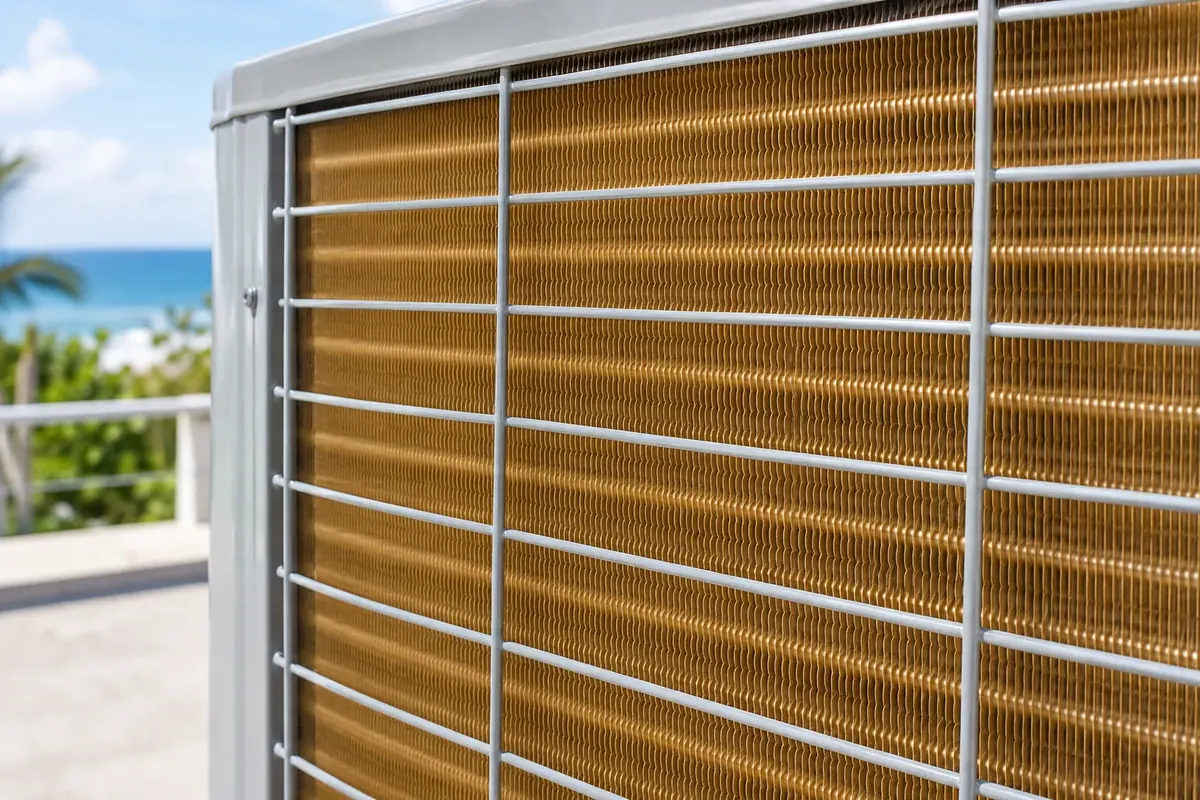
A coastal-rated AC unit is built to resist salt corrosion, with coated or all-aluminum coils, protected copper-to-aluminum joints and a corrosion-resistant cabinet. Each manufacturer does it differently, and the differences matter because most standard warranties exclude corrosion damage:
- Carrier and Bryant sell a dedicated coastal line: welded all-aluminum coils with zinc cladding, heat-shrink over every copper-to-aluminum joint, and a WeatherArmor Ultra cabinet. Unusually, it carries a five-year parts warranty where the failure mechanism is seacoast corrosion. Cosmetic corrosion is still excluded.
- Trane uses an all-aluminum "Spine Fin" outdoor coil, offers epoxy-coated models for installations within a mile of salt water, and sells a seacoast protection kit and a separate kit for variable-speed drive electronics.
- Lennox fits a proprietary aluminum alloy coil it markets as resistant to salt, without publishing a distance threshold.
- Daikin ships its FIT heat pump with a "Blue Fin" coating rated to more than 1,000 hours of salt-spray testing as standard.
- Goodman and Rheem: we found no coastal product or coating option in either company's current residential literature.
The part that matters most to a homeowner is the warranty language. Standard warranties from Carrier, Trane, Lennox and Goodman all exclude damage from a corrosive atmosphere, and Trane and Lennox name salt in the list. Bryant's warranty defines "seacoast corrosion" as exposure to sodium chloride and similar compounds. A standard unit installed on the Gulf front is, in warranty terms, on its own. That is the strongest argument for paying the coastal premium rather than relying on a rinse schedule alone.
Our AC installation and replacement page covers how we specify equipment for coastal exposure and what the options cost relative to a standard unit.
Where does salt corrosion show up first on an AC unit?
Salt corrosion shows up first on the outdoor coil fins, as white powder, pitting or crumbling metal, followed by rust at the cabinet seams and fasteners and crusting at the copper-to-aluminum joints. The electrical compartment, condensate drain and refrigerant line insulation are the next places to check.
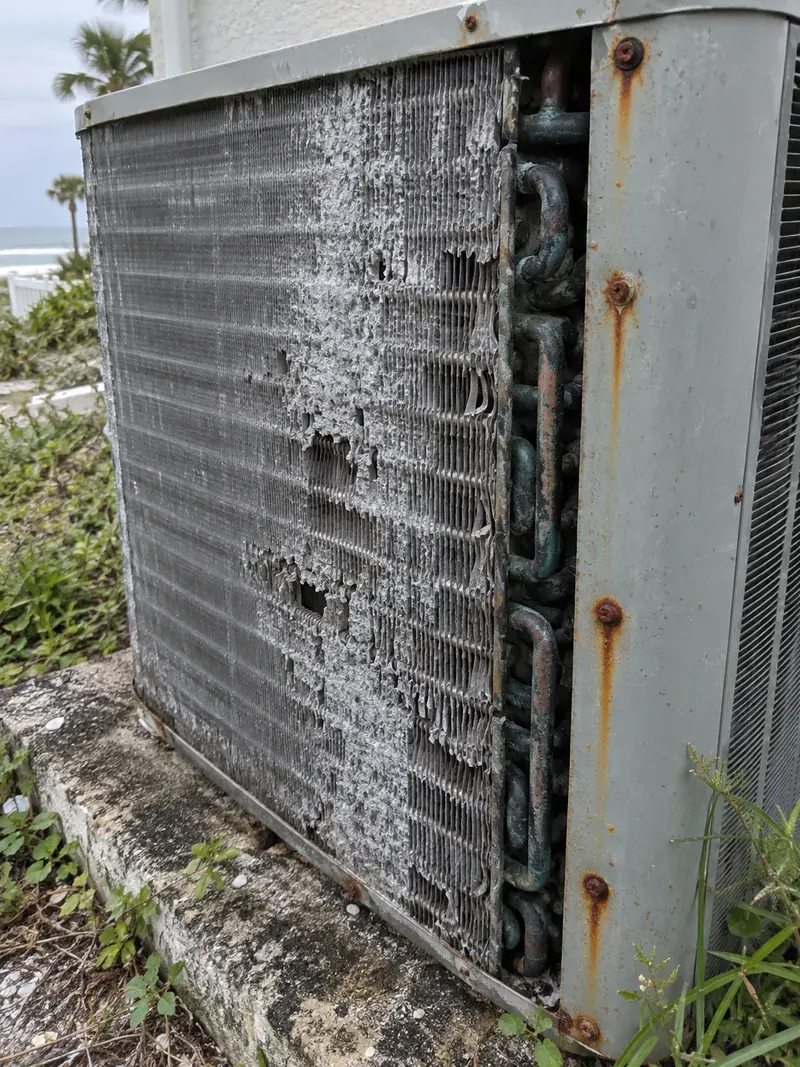
- Outdoor coil fins. White powdery deposits, pitting, or fins that crumble when brushed. Corroded fins cannot shed heat, so the system runs longer for the same result.
- Cabinet and base pan. Rust at seams and around fasteners is usually the earliest visible sign. A base pan that has rusted through will not drain.
- Brazed joints. Anywhere copper meets aluminum is a galvanic site. Green or white crusting at a joint is corrosion in progress.
- Electrical compartment. Terminals, contactors and control boards sit in the same salt air. Trane's drive-protection kit exists because manufacturers see this failure mode; field data on the life of electrical components near the coast is thin, so treat it as an exposure rather than a quantified risk.
- Condensate drain. Heavy dehumidification means heavy condensate. A partially blocked line backs up until the float switch trips and shuts the system down, which is doing its job: the International Mechanical Code, which Florida's mechanical code follows, calls for a water-level switch that shuts the equipment off where an auxiliary drain pan is not fitted.
- Refrigerant line insulation. Sun and salt degrade the foam sleeve on the suction line. Bare line loses capacity and sweats onto whatever is below it.
How often should you service an AC near the beach?
Service an AC near the beach on a tighter schedule than inland: change the filter every one to two months in summer, rinse the outdoor coil with fresh water about every three months, and book two professional checks a year, a pre-season visit in spring and a corrosion check in the fall.
ENERGY STAR recommends an annual pre-season check and a monthly look at the filter; the fall visit is our coastal addition, for the fins, joints and cabinet. Here is the rhythm, with federal guidance and our coastal additions kept separate.
- Filters every one to two months in the cooling season. That is the Department of Energy's interval, with a note that constant use calls for more frequent attention, which describes a Bay County summer. ENERGY STAR puts the efficiency loss from restricted airflow at up to 15 percent, and the University of Florida's extension service calls dirt on the indoor coil the single most common cause of poor efficiency. In a rental with back-to-back guests, change it between stays.
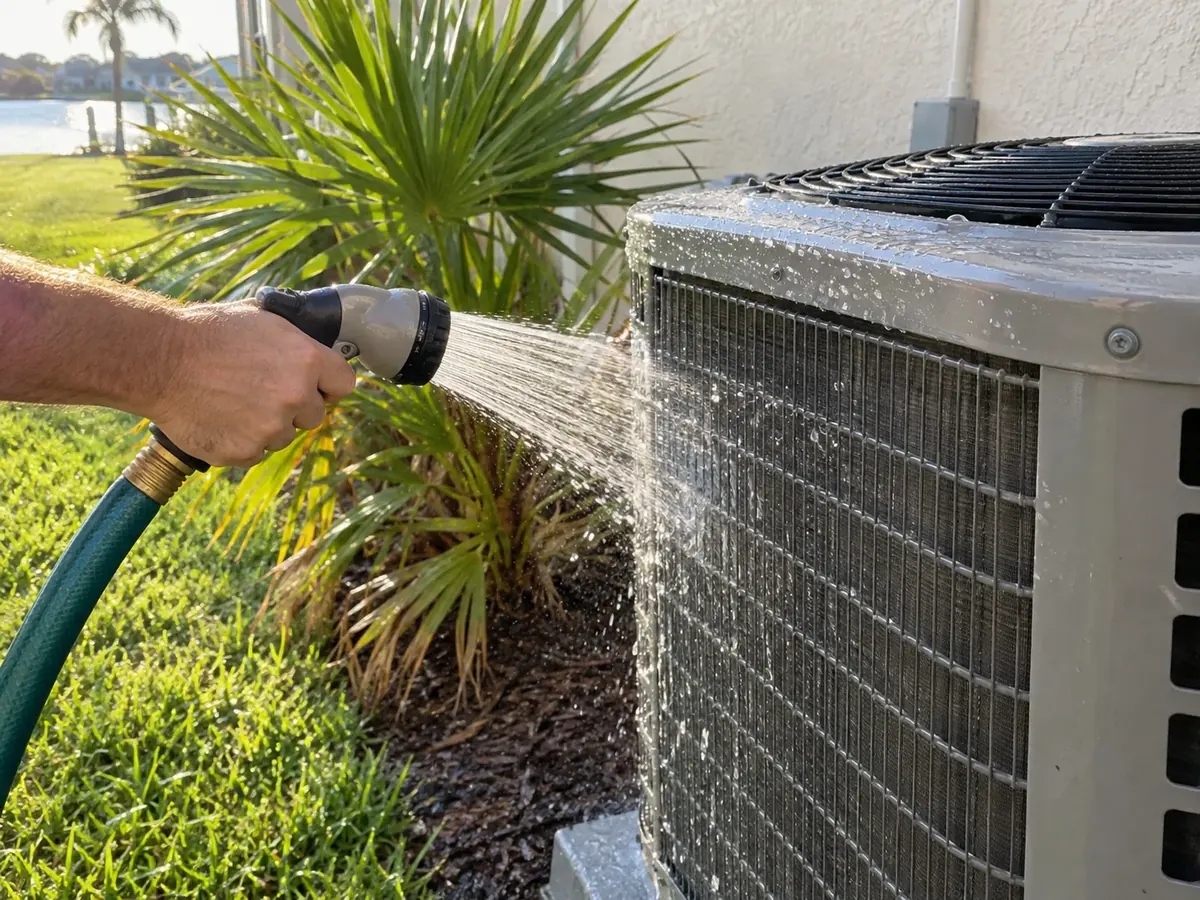
- Rinse the outdoor coil roughly every three months. That is Carrier's own interval for coastal locations. Garden hose, low pressure, water directed outward through the fins, power isolated at the disconnect first. A pressure washer bends fins and makes things worse. Many coastal contractors suggest monthly in season; there is no harm in it.
- Two feet of clearance on every side. The Department of Energy's figure. Clear leaves and clippings from the fins and resist planting shrubs tight against the cabinet for shade. Restricted airflow costs more than the shade saves.
- Keep the condensate line clear. Pass a stiff wire through the drain channels occasionally, as DOE suggests, and watch for standing water in the pan. If the float switch has tripped, that is the first place to look.
- A pre-season check every spring (ENERGY STAR), plus a fall visit (our coastal addition). ENERGY STAR's pre-season checklist has the technician cleaning both coils, checking refrigerant charge and inspecting the condensate drain. The fall visit is for a close look at the coil fins, brazed joints and cabinet for corrosion after a summer of salt and storms.
How should you run the AC in an empty vacation rental?
Run the AC in an empty vacation rental on a short, deliberate early-morning cycle at a low setpoint, or run a dehumidifier on a timer for a few hours a day. Turning the thermostat up does not work: in a Florida Solar Energy Center study of unoccupied homes, an 85°F setting failed to control indoor humidity.
A property that sits empty for stretches and then runs flat out for a week of occupancy puts an unusual pattern of stress on the equipment, and failures tend to surface with a guest already in the house. The published evidence is thin and comes from that single FSEC study of three homes: with the air conditioning off, indoor humidity ran between 62 and 73 percent, and the 85°F setpoint did not bring it down. The early-morning run and the timed dehumidifier were what worked.
The rest follows from occupancy. Guests set the thermostat where they like it, filters go unchanged for a season, and nobody rinses the coil. Build those into the turnover checklist, or into a maintenance plan that covers them.
Should you repair or replace a corroded AC?
Repair a corroded AC when the system is under ten years old and the fault is isolated, such as a capacitor, contactor, fan motor or blocked drain. Replace it when the outdoor coil has corroded through, the system runs on R-22, or an older unit's compressor has failed, because in those cases a repair buys little time.
Isolated faults use inexpensive parts, and the repair restores the system to normal service. Guidance on common faults is on our air conditioning repair page.
ENERGY STAR suggests considering replacement when a heat pump or air conditioner is more than ten years old, or when it needs frequent repairs and the energy bills are rising. ASHRAE's handbook gives a median service life of around 15 years for residential split systems, with the honest caveat that the underlying data is old. Near the coast, expect less. A US Army engineering study of equipment in a severe marine environment found corrosion cutting expected life by up to half at that site, though that is one extreme location and anyone quoting a precise coastal lifespan penalty for your house is guessing.
Three things push a Bay County decision toward replacement:
- An outdoor coil corroded through. At that point a repair is a coil replacement on a cabinet that is also corroding.
- R-22 refrigerant. The EPA banned new R-22 equipment in 2010 and ended production and import in 2020. Servicing relies on recovered supply, and the economics get worse every year.
- An older system with a compressor failure. A common contractor rule of thumb is to replace when the system's age in years multiplied by the repair cost passes $5,000. It has no official origin and no research behind it; treat it as a conversation starter, not a rule.
If you are replacing in 2026, you will meet the refrigerant transition. New production moved to lower-GWP A2L refrigerants from January 2025: Carrier, Trane, Lennox ducted systems, Rheem and York use R-454B; Daikin, Goodman and Amana use R-32. In a rule finalized in May 2026 and effective in July 2026, the EPA removed the deadline for installing R-410A systems whose components were made or imported before 2025, so a contractor with remaining stock can still fit one, and existing R-410A systems can continue to be serviced. The new refrigerants are mildly flammable, which changes installation practice, so this is one more reason to use a contractor who installs them routinely. In this climate a heat pump handles both the cooling season and the handful of genuinely cold Panhandle nights; the heat pump and heating services page covers how they perform through winter.
A note on Hurricane Michael and the age of Bay County's equipment
Michael made landfall near Mexico Beach and Tyndall AFB on October 10, 2018 as a Category 5 storm with 160 mph winds, the first Category 5 to hit the United States since Andrew in 1992. The National Hurricane Center's report records more than 45,000 structures damaged and more than 1,500 destroyed in Bay County, with 1,584 of Mexico Beach's 1,692 buildings damaged and every building at Tyndall affected.
The practical consequence for HVAC is a large cohort of systems installed in the rebuild between 2019 and 2021 that are now five to seven years old and approaching the point where coastal exposure starts to show. It is reasonable to assume some were installed quickly and sized by copying the old unit; FSEC's Florida data shows that was common even in normal conditions. If your system dates from the rebuild, a proper look at the coil, joints and cabinet, and a check on whether it was sized by calculation, is worth having before the next repair rather than after it.
Questions
Salt air and coastal HVAC: common questions
How far from the Gulf does salt air affect an air conditioner?
Salt air can affect an air conditioner several miles from the Gulf, but exposure is heaviest within the first few hundred yards of the shoreline. A peer-reviewed field exposure study found salt deposition falls off sharply over that distance yet remains measurable miles inland. Manufacturers draw their own lines: Trane recommends epoxy-coated coils within one mile of salt water, and Carrier describes salt being carried as far as two miles inland. In Bay County, treat anything on the Gulf front or the bays as a coastal installation.
Does a standard AC warranty cover salt air corrosion?
Standard AC warranties usually do not cover salt air corrosion. Carrier, Trane, Lennox and Goodman all exclude damage from corrosive atmospheres, and several name salt specifically. The notable exception is Carrier's coastal product line, which carries a five-year parts warranty where the failure is caused by seacoast corrosion, though cosmetic corrosion is still excluded.
How often should I rinse the outdoor unit near the coast?
Rinse the outdoor unit about every three months near the coast, the interval Carrier's owner's manual recommends for coastal locations. Wash the coil and all exposed surfaces with a garden hose at low pressure, directing the water outward through the fins, and isolate the power first. Never use a pressure washer, which bends fins.
Why does an oversized air conditioner leave a Florida home feeling clammy?
An oversized air conditioner leaves a Florida home feeling clammy because it reaches the thermostat setting and shuts off before it has run long enough to pull much moisture out of the air. Building America research also notes that condensate left on the indoor coil can evaporate back into the airstream as the fan keeps running. In Florida, roughly a fifth of seasonal cooling energy goes on moisture removal, so short run cycles leave the house cold and damp. Correct sizing from a load calculation matters more here than in a dry climate.
What indoor humidity should I aim for?
Aim to keep indoor humidity below 60 percent, and ideally between 30 and 50 percent, which is the EPA's recommended range. Florida Solar Energy Center research treats 70 percent as the level at which mold growth becomes likely.
Can I still get R-410A equipment, or do I have to buy the new refrigerant?
You can still get R-410A equipment, because a May 2026 EPA rule, effective July 2026, lets contractors install R-410A systems whose components were made or imported before 2025. New production moved to lower-GWP refrigerants, mainly R-454B and R-32, from January 2025, so R-410A is limited to remaining stock. Existing R-410A systems can continue to be serviced. R-22 is different: production ended in 2020 and servicing relies on recovered supply that gets dearer each year. You are not required to replace a working R-22 system, but a major R-22 repair is usually poor value.
Sources
Researched against the sources below and last reviewed October 17, 2026. Figures are quoted with their dates; where the evidence is dated or thin, the text says so.
This guide draws on primary and authoritative sources rather than contractor claims. Where the evidence is thin, the text says so.
- ASHRAE Journal, Controlling Corrosion in Marine Refrigeration Systems (2011)
- AMPP, Galvanic corrosion
- Institute of Corrosion, Recognising hidden formicary corrosion (2023)
- Carrier, Coastal heating and air; Carrier heat pump owner's manual on coastal maintenance intervals
- Trane, Residential product catalog (2023), coastal application notes
- US Department of Energy, Maintaining your air conditioner
- ENERGY STAR, Heating and cooling maintenance checklist and When to replace
- UF/IFAS Extension, Energy efficient homes: air conditioning (rev. 2025)
- Building America, Why right-size?; DOE/FSEC, Right-size heating and cooling equipment
- Florida Solar Energy Center, Oversizing of air conditioning systems in Florida and Humidity control in unoccupied Florida homes
- Florida Building Commission, Energy efficiency and moisture control in the Florida climate (2007)
- US EPA, A brief guide to mold, moisture and your home; HCFC phase-out for technicians; Technology Transitions final rule (2023)
- NOAA NCEI, Engineering weather data, Tyndall AFB; Florida Climate Center, Relative humidity normals
- National Hurricane Center, Tropical cyclone report: Hurricane Michael (2019)
- US Army ERDC-CERL, Corrosion-resistant HVAC coil coatings in a severe marine environment (2015)
- US EPA, Technology Transitions rule amendment, May 2026 (FR Doc. 2026-10387), removing the installation deadline for pre-2025 R-410A equipment
- Bryant, Air conditioner and heat pump limited warranty (seacoast corrosion definition)
- Revista de Metalurgia, Corrosion of 1050 aluminium in coastal atmospheres (peer-reviewed field exposure study)
- National Weather Service Tallahassee, Panama City climate normals (1991 to 2020): days at or above 90°F
Not sure what the salt has done to your system?
A pre-season check covers the coil fins, brazed joints, cabinet, drain and refrigerant charge, and tells you whether the system was sized right in the first place. Free estimates across Bay County, and a written quote before any work begins.